

I live in Almaty Kazakhstan. It’s not known as a hotbed of semiconductors (yet). When I first met Nursultan Kabylkas, and learned his background, I had to hear his story.
This is the story of how one professor led a team of students to design the first chip in Kazakhstan's history, and in doing so, may have birthed a whole new national industry.
TL:DR:
The Win: Kazakhstan’s first student-designed RISC-V chip.
The Strategy: Skipping the “fab-first” trap by specializing in verification via Texer.AI and Reasonbase.io
The Takeaway: Strategy + intellectual capital > Physical capital. You don’t need a fab to own a piece of the global supply chain.
Kazakhstan’s First Chip
Nursultan’s journey began at AMD in the United States, where he worked on silicon verification. When he returned to Kazakhstan in 2023 to teach engineering, he found a desert; the local semiconductor landscape was limited mostly to FPGA programming and encryption devices. When he shared his dream of bringing "real" silicon design to the country, he was met with skepticism. In his own words, he was laughed at. Most people jumped straight to the "billion-dollar fab" problem, assuming that without a massive manufacturing plant, the industry couldn't exist.
Nursultan kept looking for an inspiring project to give his students a hands on project, a project that would move the needle through talent rather than infrastructure. Realizing that the key to developing an ecosystem here needed to start with talent, Nursultan focused in on design and verification. He found his catalyst in the “One Student, one Chip Initiative” from the Chinese Academy of Sciences. The program gave him a framework to get started, and after recruiting some enthusiastic students at Nazarbayev University they began designing the first chips.
Through a partnership with a Chinese fab, the team got space on Multi-Project Wafer (MPW) and received back their RISC-V general purpose processor. The project went viral, the media caught on, and the project gained national attention.
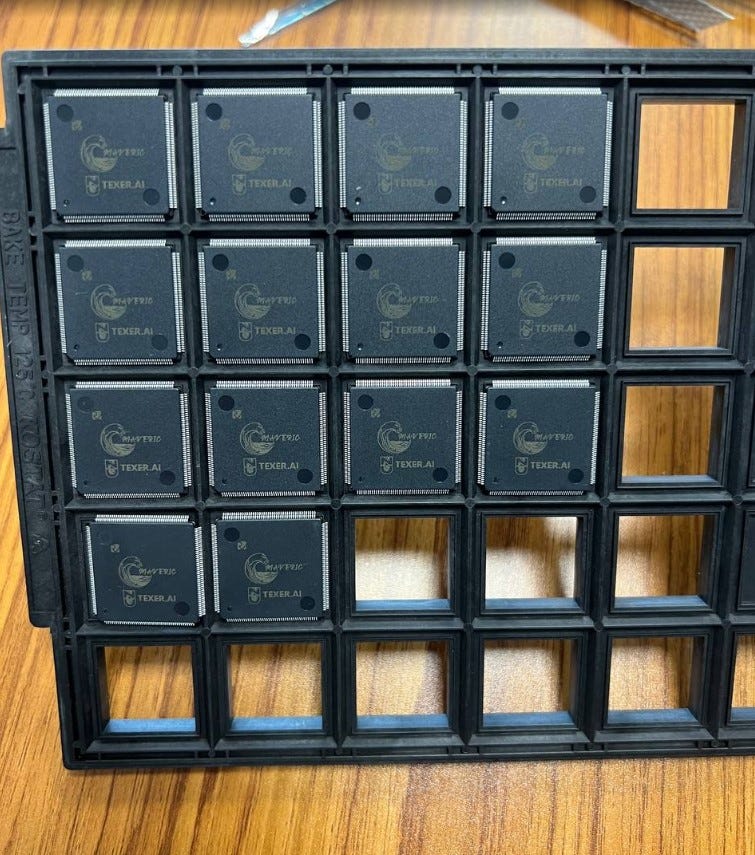
The project completely shifted the conversation, as Nursultan puts it,
Before people were laughing . . . but after the chip came back, people started pointing me in different directions and mechanisms . . .
The conversation changes from ‘It’s impossible’ to ‘How do we scale it?’
From the beginning, Nursultans’ vision has looked beyond the academic track, with a plan to build something even bigger in Kazakhstan.
Bootstrapping the Ecosystem
Nursultan didn't just want a trophy for the university trophy case; he wanted a self-sustaining industry. To turn this academic momentum into a commercial reality, he and his team launched Texer.AI, a verification company designed to employ the very students who went through his program. Further along, he also co-founded ReasonBase.io, a similar company bridging the SF Bay Area and Astana, to apply verification logic to other industries.
By building a company around the chip’s success, Nursultan has created a “revolving door” between the classroom and the market. Through Texer.AI, specialized publications, and local conferences, he is guiding students directly into high-value engineering roles. This is bootstrapping at its finest: using a single successful project to fund the talent pipeline that will power the next ten projects.
The Verification Specialization
The engine driving this revolving door is a deliberate choice to skip the “fab-first” mentality. The strategy is clever: specialize in Verification. In the semiconductor world, verification is the rigorous process of mathematically proving a design works before a single dollar is spent on manufacturing.
Verification offers a low-barrier, high-margin entry point. It requires mastery of complex tools and logic rather than multi-billion dollar cleanrooms. This “capital-efficient” on-ramp allows a startup like Texer.AI to establish global credibility and attract international partnerships without needing a local factory. By focusing on high-skill employment first, Nursultan’s vision for Kazakhstan is seeding a talent pipeline that is far more essential to long-term growth than any piece of hardware.
Kickstarting a Global Blueprint
This story carries a resonance far beyond Almaty, especially as more nations chase the dream of “semiconductor sovereignty.” Nursultan’s path provides a blueprint for emerging economies: you don’t need a massive capital investment to join the global supply chain.
Innovation can start with niche expertise. By focusing on segments like design, verification, or encryption, a country can build its capabilities incrementally. Shifting the focus away from the “full manufacturing plant” requirement opens doors for any economy with a strong mathematical and engineering foundation to develop a resilient, sovereign industry.
Shifting from the assumption that you need a full manufacturing plant to participate in semiconductors opens pathways for emerging economies to develop a sovereign and resilient industry.
Nursultan’s vision for Kazakhstan, an approach of cultivating verified processor design and leveraging open-source tools exemplifies how targeted, skill-based initiatives create foundational assets for broader industry development.
Kazakhstan’s Future
Ultimately, the future of the Kazakh ecosystem relies on expanding these specialized clusters. By starting with a simple RISC-V processor and moving into complex supply chain applications, Nursultan has proven that the “impossible” is actually just a series of small, iterative steps.
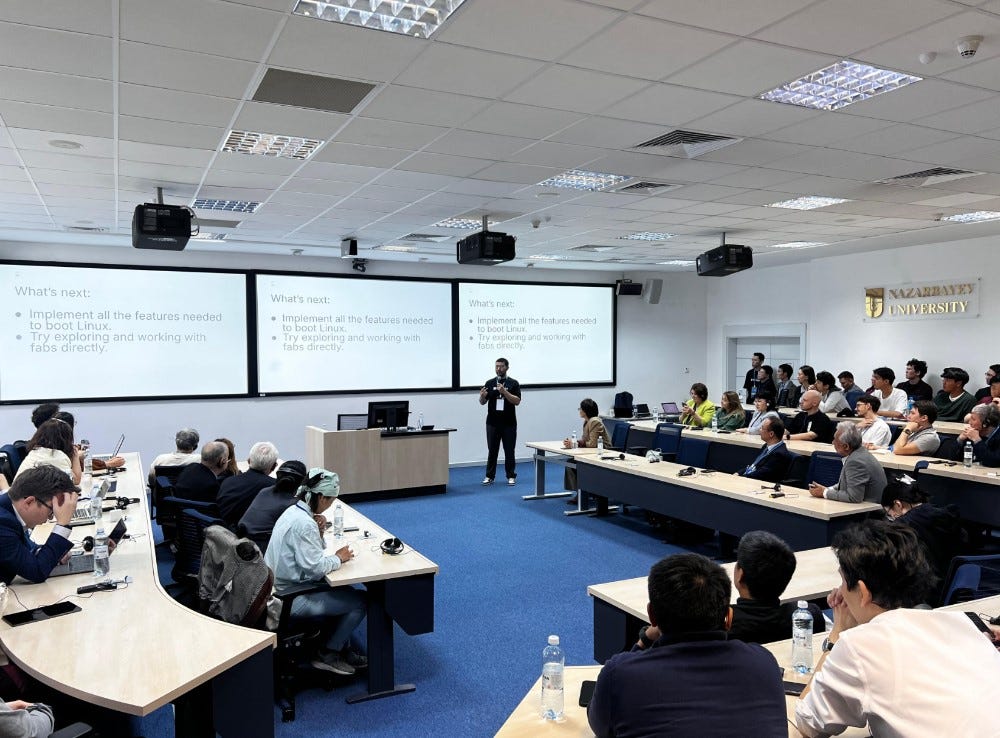
Creating a core niche and nurturing the startups within it fosters a self-reinforcing cycle of talent and investment. Kazakhstan is no longer “ecosystem absent”—it is on its way to becoming a vibrant, sustainable innovation hub, one verified line of code at a time.
Keeping Up With Nursultan
You can keep up with Nursultan and his sprawling semiconductor empire:


